On the heels of the successful conference in Munich, the ECPR Standing Group on Parliaments (SGoP) invites you to submit your proposals for the conference next year. The fourth conference of the SGoP is being hosted by Stefanie Bailer and Tamaki Ohmura at the University of Basel.
The conference will bring together senior and junior scholars of the field. Away from the hectic bustle of large-scale conferences it will offer unique opportunities for detailed discussions and networking. The academic programme will be completed by a social programme including a welcome reception allowing us ample time to catch up with old friends and to meet new members as well as a reception and a conference dinner on the second evening of the conference.
We invite papers that deal with the empirical study of parliaments and legislatures. As it proved successful in Dublin, Vienna, and Munich, the exact thematic and regional range of papers is deliberately broad.
We are inviting proposals:
- either for individual papers
- or for entire panels consisting of three to four papers
Abstracts of proposed individual papers should be between 200 and 300 words. Proposals for panels should name a panel chair, discussant, the names of all proposed participants and abstracts for their individual papers.
Proposals should be sent to parliaments.2017@gmail.com.
Deadline for submissions: 6 January 2017
Proposals will be evaluated by 27 January 2017
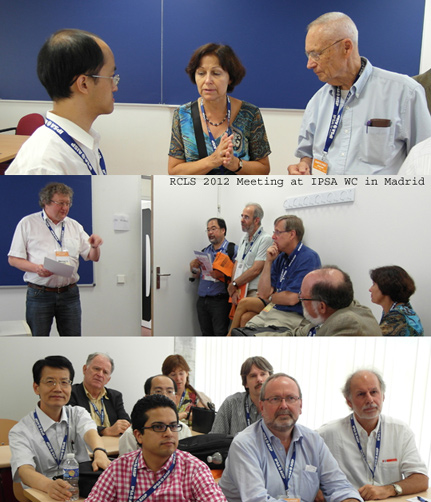
 RCLS met in Prague together with RECON WP3 for a workshop on "Changing Modes of Parliamentary Representation". The conference underlined the great variety of parliamentary research in both theoretical and methodological terms: Papers dealt with national parliaments and the EU, the EP, parliaments in the process of democratization and institutionalization, the theory of institutional evolution, the theory and practices of representation in Europe, France and Germany, socialization of newly elected MPs, corporatism and the revival of parliaments. The presented research dealt with purely theoretical topics, some relied on a heavily quantitative, others on a purely qualitative methodology, and some sought to combine both approaches.